
Post #3: Time to run the machine for the next 100 years
I am in the final stages of my series of posts, sharing my experiences with various hydroelectric projects in Venezuela and Canada. Throughout this series, I have offered insights from the perspectives of a Project Manager, Maintenance Engineer, and Plant Manager. In this third post, we will focus on the operational stage. Finally, after all the planning and commissioning, your new or recently refurbished plant is now in commercial operations.
Out of the three posts, this stage is perhaps the most challenging as it involves labor relations, geographical factors, equipment requirements, and the needs of the workforce. While I will specifically discuss the generation aspect, please note that the transmission aspect will be addressed in a dedicated post in the future.
On the past two posts we talked about the planning stage and the commissioning stage of a hydro project. During the planning stage we mentioned that, from the beginning, the design of the plant should be defined based on how we want to operate it, and we will complement that idea here, adding that it is an iterative process, that in fact may take years and different approaches to find the best operational model for the facility.
To approach it, we will simplify it with the three cases that we discussed on the first post.
Fully Local Operations
This type of operational approach is commonly found in large hydro plants, regardless of their location. A large plant (which I personally consider to be over 800 MW with at least 4 machines) typically has a complex balance of plant (BOP) and requires constant monitoring.
Having human presence in the operations of a plant brings several benefits, including:
- Quicker response to emergencies
- Higher reliability in operations, with human presence serving as an additional backup layer to resolve issues
- Improved efficiency in monitoring operations, coordinating work, and conducting maintenance activities, thanks to the continuous presence of the same individuals, fostering higher team synergy
However, human presence also presents challenges, such as:
- Higher operation costs in most cases
- Different emergency preparedness considerations with humans on site
- The need for support systems to be in place, including waste management, domestic water, heating and cooling, transportation, emergency shelter, food, etc.
Large plants, such as the 10,000 MW Guri in Venezuela or the 5,600 MW Churchill Falls in Canada, often require the construction of a town near the site. The asset owner is then responsible not only for the plants and workers but also for the well-being of their families in the plant’s town.
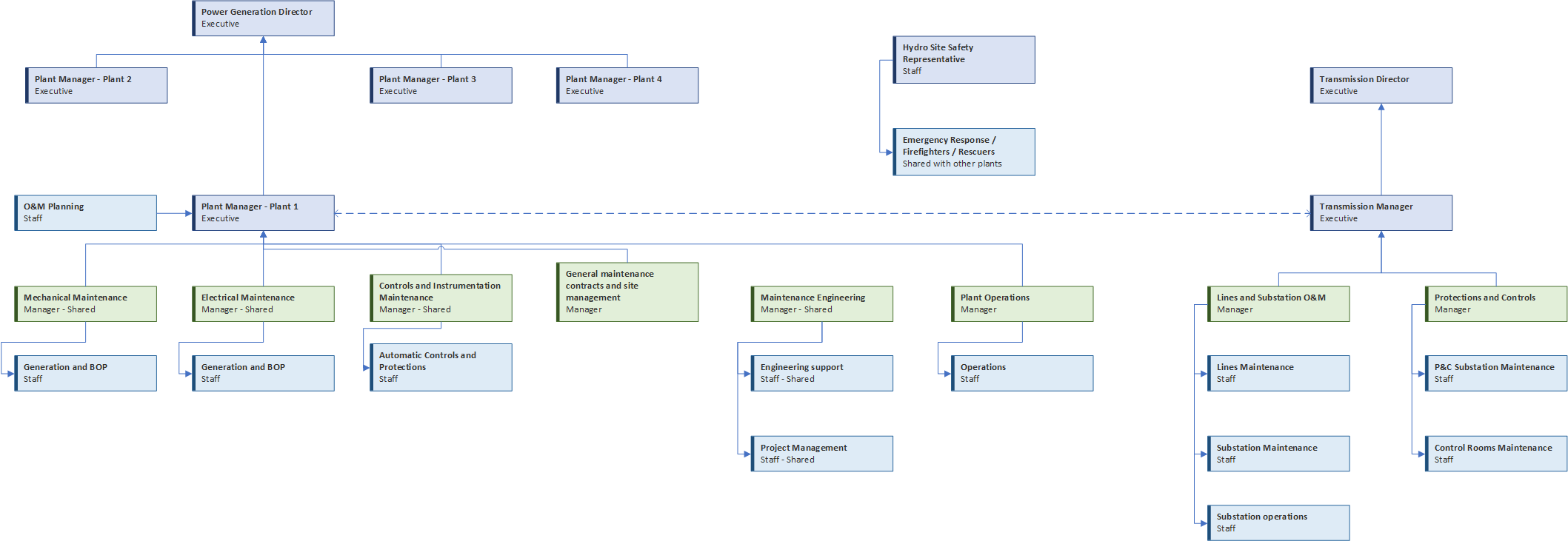
The organizational chart for these types of plants tends to be extensive. Two approaches can be considered for big plants: the “self-sufficient approach” and the “shared resources approach.”
Self-Sufficient Approach
In the self-sufficient approach, the plant roster includes representation from the majority, if not all, of the technical and administrative disciplines. Essentially, the plant operates as an almost independent company separate from the utility. This approach proves practical when the complexity and/or remoteness of the installation make dependency on centralized utility resources inefficient.
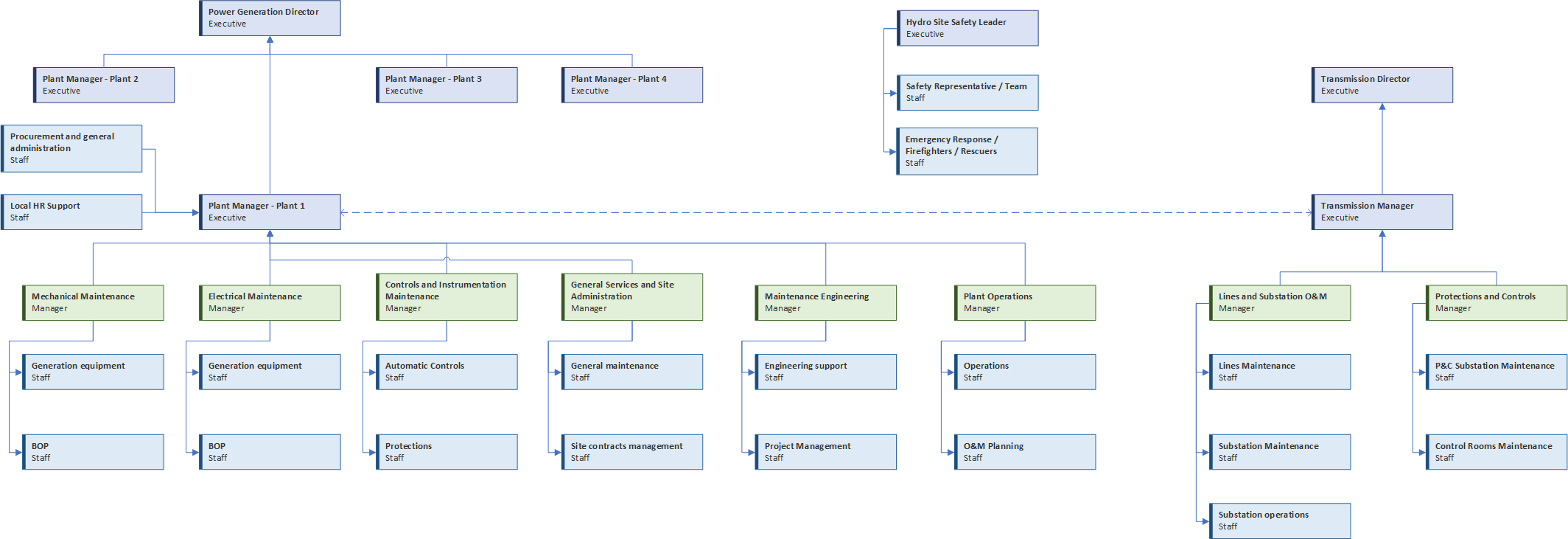
In the organizational chart, Transmission is intentionally shown separately because many utilities have a dedicated Transmission division. The plant has its own procurement support team and HR support team, as well as administrative staff. This organizational model is referred to as self-sufficient because it demonstrates the plant’s ability to operate autonomously and meet its own needs without relying heavily on external resources.
Shared Resources Approach
The shared resources approach is commonly used for smaller plants or when the utility has a series of plants in close proximity or within a predefined operational region. In this approach, a smaller maintenance and operations team is present on the plant, with operators typically working on a 24/7 basis and maintenance crews available on business days and during emergencies.
As depicted in the organizational chart, the number of positions or “boxes” is reduced compared to the self-sufficient approach, reflecting the smaller teams involved. The maintenance teams are often shared among multiple plants and assets, and maintenance engineering does not directly report to the plant manager but is shared across the plants.
While this approach can be financially efficient, it presents challenges in terms of logistics, coordination, and priority setting. Effective communication between different team leads, managers, and the planning team is crucial for coordinating shared resources effectively among the plants.
Local Operations and Seasonal Maintenance
The local operations and seasonal maintenance approach involves maintaining a small team for day-to-day operations and an on-call or seasonal maintenance team. This approach is feasible in locations where a nearby community can provide accommodations for the personnel.
In this case, a plant manager oversees several plants or a system of plants typically located in the same region. Each system or plant has its own dedicated operations and maintenance team. Operators may not be present on a 24/7 basis but are available if needed. The maintenance teams are small, and sometimes the operators themselves perform basic maintenance tasks, while major maintenance is carried out by a dedicated shared team.
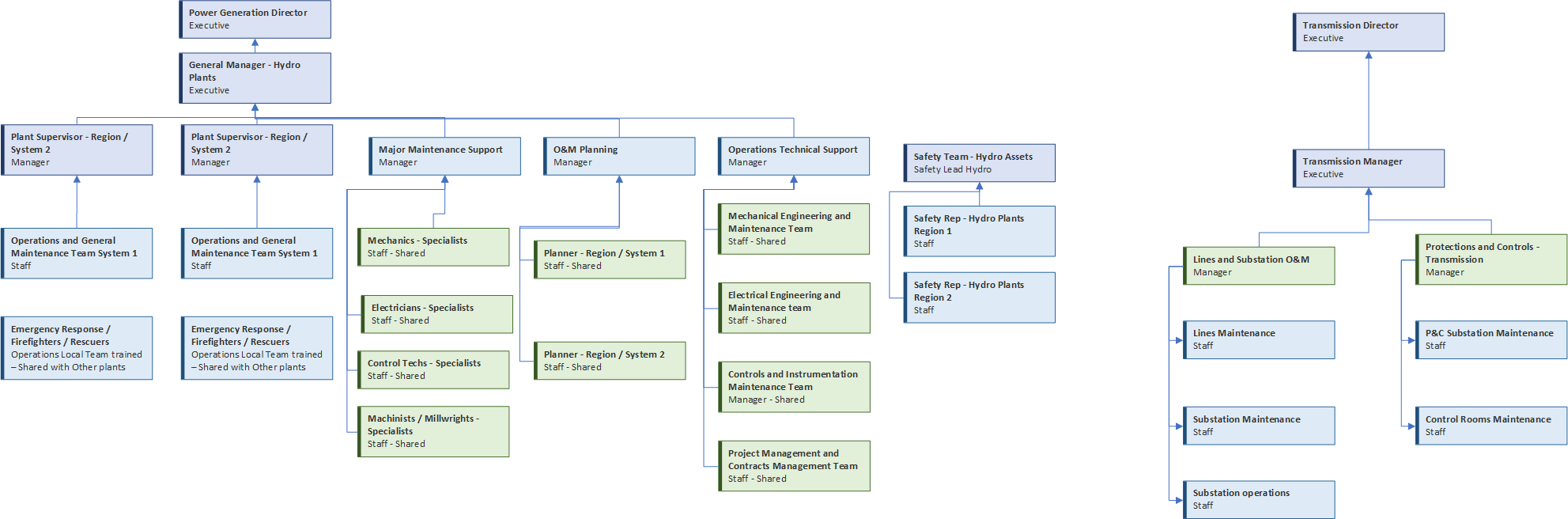
This philosophy also involves a shared pool of engineers who support operations, maintenance, project management, and contract management tasks. Safety remains independent of any manager and may have dedicated representatives for each region.
Fully Remote Operations
In the fully remote operations approach, there is no on-site operations team present unless there is a failure or during maintenance season. Instead, a control center is located in a different geographic area, which is common for very remote facilities.
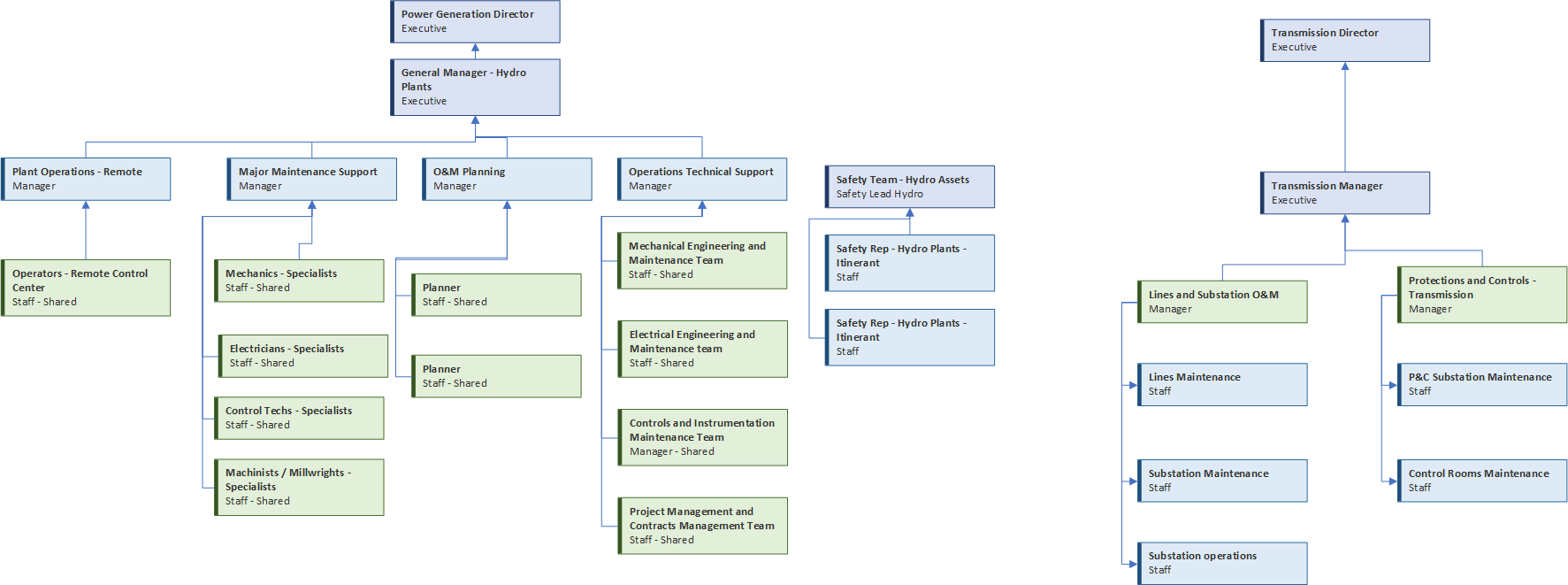
In this approach, it is important to allocate significant capital investment to ensure backup systems are in place for various subsystems and to implement state-of-the-art on-site diagnostics and data acquisition for the entire site, not just the generation equipment. Building a fully self-sufficient facility that can operate without human intervention for extended periods is crucial.
An important aspect of fully remote operations is heavy reliance on Original Equipment Manufacturer (OEM) and third-party support for maintenance and troubleshooting, particularly due to the remoteness of the facilities. It is advisable to consider this reliance during the project conceptualization phase, planning and budgeting in advance for the potential costs of ongoing support during operations.
While this approach requires substantial capital investment, it minimizes labor costs.
Final Thoughts on Operations
In conclusion, there is no one-size-fits-all approach to operating and maintaining hydro plants. The scenarios discussed in this series are just a few examples, and the actual approach may vary greatly depending on the organization and the specific circumstances of the hydro plant. It often takes years of trial and error to find the most effective and safe way to operate these assets.
Looking ahead, the future of hydro plant operations may lean towards full remote operation rather than constant on-site presence. The ongoing advancements in operations supervision technology are driving this shift, with the goal of maximizing the reliability and uninterrupted operation of the machines for as long as there is water to generate power.
However, whether full remote operation is a good or bad thing remains to be seen. Time will tell how it evolves and if it proves to be the optimal approach for hydro plants. It is an area open for discussion and consideration.
What do you think should be taken into account when operating a hydro plant or a system of plants? Let’s continue the conversation!